

Report: Institutional Alignment for Enrollment and Fiscal Health
A Framework for Sustainable Enrollment Management in a Changing Higher Education Market

Higher education institutions are confronting significant enrollment and financial pressures. Yet the instinctive response to recruit more students often addresses the symptom rather than the underlying problem. Sustainable enrollment is not solely an admissions challenge. It is an institutional outcome.
Enrollment goals, pricing and financial aid, academic offerings, marketing, student experience, budgeting, technology, and operations all influence whether an institution can attract students, enroll them, support their success, and generate the revenue necessary to fulfill its mission. Strategic Enrollment Management (SEM) was conceived around this idea. Its original vision was to bring together functions related to recruiting, funding, tracking, and supporting students that too often operated independently. Today, the need for that integration is even greater.
BPS believes modern SEM must extend beyond enrollment operations to create institutional alignment and shared ownership around enrollment and fiscal health.
This report presents seven standards for achieving that alignment and a framework institutions can use to examine where fragmentation may be limiting their performance.
An old enrollment challenge in a new enrollment environment
In 1976, Boston College Dean of Admissions John Maguire warned that higher education was entering a period characterized by application and enrollment declines, financial pressure, declining morale, and the potential for institutional closures and mergers.
Nearly 50 years later, the language feels remarkably current. But the lesson isn't simply that higher education has faced difficult markets before. It is that Enrollment Management itself emerged as a response to those conditions.
Maguire proposed bringing together the disparate functions affecting students as they moved toward, through, and away from an institution. The objective was to reduce fragmentation by integrating those activities into a larger institutional design. The concept subsequently evolved into Strategic Enrollment Management: an organizational approach connecting enrollment with net tuition revenue, institutional planning, student choice, retention, outcomes, financial aid, student support, and academic decision-making.
The underlying principle remains highly relevant: Enrollment performance is produced by an institutional system, not an enrollment office.
When enrollment goals and institutional reality diverge
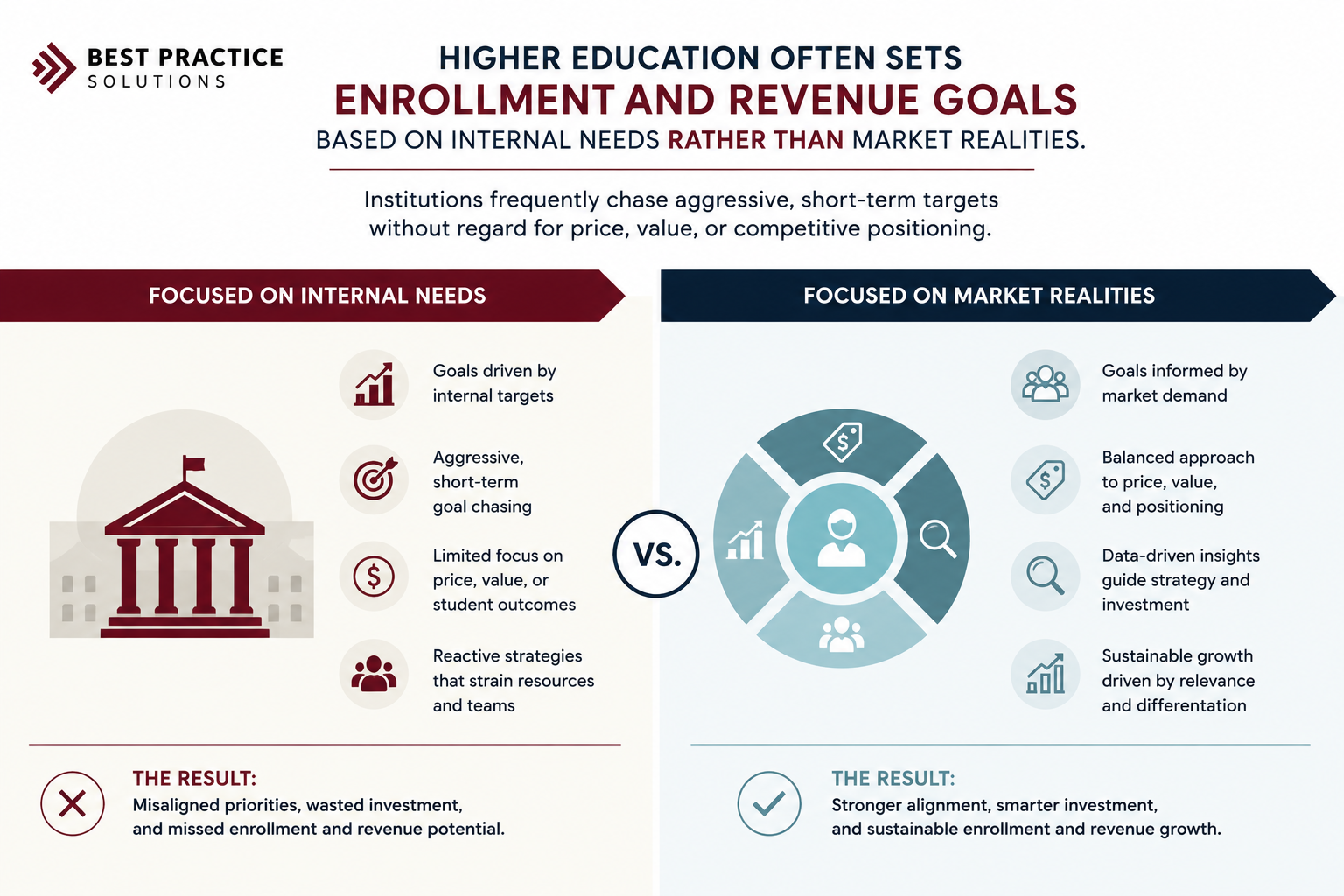
Many enrollment problems begin well before a recruitment campaign launches. Institutions establish enrollment and revenue targets based on what they need: a particular incoming class, a desired level of net tuition revenue, or a budget that must balance. But institutional need does not determine market demand.
When enrollment goals are disconnected from market realities, the institution can enter a damaging cycle: ambitious targets are established, the market responds differently than expected, revenue falls short, budgets must be reduced, and the resulting cuts diminish the institution's capacity to improve future performance. The symposium presentation describes this as the reactive budget cycle.
The natural response is often: “We just need to recruit more students.” But recruiting harder cannot, by itself, resolve questions about program demand, pricing, affordability, retention, student experience, brand position, resource allocation, or institutional capacity. Those are institutional questions.
The alignment imperative
The difference between institutions positioned for sustainable enrollment and those caught in recurring enrollment crises is not simply the effectiveness of their recruiters. It is the degree to which the institution is aligned.
In a fragmented model, admissions may own an enrollment goal it cannot independently achieve. Academic decisions may be made without sufficient consideration of student demand. Marketing may be asked to generate interest without clarity about institutional capacity or financial realities. Finance may construct budgets without adequate connection to realistic enrollment potential. When results fall short, accountability tends to converge on enrollment.
An aligned institution operates differently. Enrollment is collectively owned. Decisions are informed by data. Resources follow strategy. Finance and enrollment collaborate before budgets and pricing assumptions are established. Success—and accountability—is shared. The difference isn't better recruitment. It's better alignment.
Seven standards for enrollment & fiscal health
BPS's framework for modern SEM identifies seven interconnected standards institutions should examine when assessing their ability to achieve sustainable enrollment and financial outcomes.
01 — Organizational Alignment & Shared Ownership
Enrollment cannot be delegated to one division. Leadership, academics, finance, enrollment, marketing, student affairs, and other stakeholders need shared goals, clearly defined responsibilities, and ongoing mechanisms for coordination.
02 — Data-Informed Enrollment & Continuous Improvement
Enrollment strategy should begin with evidence rather than aspiration. Institutions need reliable business intelligence, disciplined analysis, measurable performance indicators, and the willingness to adjust strategy as conditions change.
03 — Authentic Brand Management & Effective Marketing
Strong marketing begins with understanding the institution's actual competitive position. Market research should inform whom an institution can realistically serve, what differentiates it, and where marketing investments can produce meaningful enrollment results.
04 — Integrated, Student-Centered Planning
The student experience does not begin when a student deposits—or end when recruitment hands the student to another office. Recruitment, enrollment, onboarding, and the transition into the institution should form a coherent experience that builds value, belonging, and preparedness.
05 — Effective & Compliant Financial Aid
Financial aid is simultaneously a student service, an enrollment function, a compliance responsibility, and a significant contributor to institutional revenue strategy. Its effectiveness depends on timely, accurate operations that support both students and institutional objectives.
06 — Budget Alignment
Enrollment goals, revenue assumptions, pricing, expenditures, and institutional capacity cannot be planned independently. Sustainable budgeting requires realistic enrollment assumptions and deliberate alignment between institutional ambitions and available resources.
07 — Operational Excellence
Strategy only matters if the institution can execute it. Effective processes, technology, systems, staffing, communication, and accountability provide the operational foundation required to translate enrollment strategy into results.
From enrollment strategy to institutional strategy
The seven standards are intentionally interconnected. A sophisticated recruitment strategy cannot compensate indefinitely for weak market positioning. Better marketing cannot overcome an unsustainable financial model. Strong demand cannot produce enrollment if operational barriers prevent students from completing the process. And an enrollment target cannot become realistic simply because the institution's budget depends upon it.
That is why the starting question should not be: How do we recruit more students?
It should be: How well is our institution aligned to achieve the enrollment and fiscal outcomes we need?
The distinction changes the conversation from tactics to institutional capability.
Alignment drives enrollment. Enrollment strengthens the future.
The pressures facing higher education make it tempting to focus on the next class, the next cycle, or the next revenue target. Modern SEM requires a longer view.
Institutions that align their people, priorities, resources, data, and operations around realistic enrollment and financial objectives are better positioned not only to respond to today's market—but to build the institutional capacity necessary to navigate whatever comes next.
That is ultimately the purpose of alignment: not simply to enroll more students, but to create a stronger and more sustainable institution.


Explore BPS
Better outcomes start with better alignment.
Best Practice Solutions helps colleges and universities strengthen enrollment and fiscal health by bringing strategy, people, data, and operations into alignment. We combine deep higher education experience with practical, evidence-informed approaches designed around each institution’s mission, market, and goals.
Explore our work, meet our team, discover who we help, and see the thinking shaping our approach.